
Master the 1000+ Most Common Words and Understand 60.5%+ of Real-Life Japanese
* limited spots available (due to our capacity to correct your Japanese and help you make your Japanese sound natural.)
Understand Native Speakers. Not Just Textbooks.
How much Japanese will you learn?
You will start understanding native Japanese speakers and native content such as anime without subtitles
At this level, you can continue learning Japanese through immersion by enjoying Japanese media, talking to Japanese people, or watching critically unacclaimed anime for “educational purposes”.
Reviews
Japanese Vocabulary: The Shortcut is by far the most helpful language course I've ever taken and a perfect pairing with Japanese media for learning the language. Using other applications like Duolingo, Pimsleur, Lingodeer, etc. I never felt comfortable speaking with natives no matter how much I used those apps because they taught boring textbook Ja ... panese which made it more difficult to focus and learn the words they were trying to teach me. This is just from my experience using the course for about 7 months now. I still have a lot more to learn on the course and I'm only on the first level, but I feel more comfortable practicing what I have learned with friends who are native speakers. The realistic practice dialogues and quizzes are an effective way to remember many words in each sentence and I'm always looking forward to learning or practicing words I don't know or remember as well. I look forward to continuing to use the course for the foreseeable future to further advance my knowledge and proficiency with the language in preparation for my future visits to Japan.
Read more

Solid program for using dialogues to learn usage, vocab, and grammar. They upload fresh dialogues to all levels weekly, and there’s a large archive. The quizzes help reinforce your learning. Each sentence is broken out in audio and in writing and each word in the dialogues is explained well. Don’t let the heavy advertising put you off, it’s a ... good program that’s really improved my learning. I was getting a little bored with other learning methods and wanted to increase my exposure to the language, and I’m glad I chose JVS. Really good for the upper beginner/early intermediate language learner.
Read moreLove it so far ☺️ it’s different from the typical course but it teaches you real Japanese spoken every day by locals rather than textbook Japanese. It’s like opening the door to a new world. There’s a lot to learn but everyone is very supportive and they always reach out to check in with you and help you. You get feedback from the teacher ... on your homework after every unit, which is optional, but I think super important, so you can put what you learn into practice, and you get feedback quite quickly, within a few days. I’m enjoying it so far and would recommend to people trying to self learn Japanese like me..
Read moreI've been studying Japanese for a few years and I am an English-speaker. So, the language has been a little daunting to say the least. Vocabulary has been quite an effort, so I thought I'd try Yuta's JVS. Since I have learned mostly the polite side of Japanese from textbooks, I was surprised that the "natural, native" sentence structure was really ... different. I talked with my Japanese friends and they said "Yeah, that's the way we talk with each other." I really like the dialogues because they are nuanced, repetitive for the vocabulary, and quite fun. The program seems to reinforce the learning that I have done in the past and it seems to stick better than flashcards or workbook lessons. I've been trying it out for a little over a month and I'm interested to continue. Thanks for all you help.
Read moreIs This the Right Course For You?

- You’ve learned some Japanese, but you have trouble constructing sentences on your own.
- It takes too much time to understand Japanese sentences, other than phrases like “waku waku” or “yamete”.
- You have trouble understanding real-life Japanese people.
- You have trouble understanding anime, TV shows, films, books, or YouTube videos without subtitles.
- You are always a “beginner”. But you want to get out of the “beginner zone”.
- You don’t have access to native Japanese teachers to correct your Japanese.
- You don’t like rote memorisation.
- You’ve learned Japanese from textbooks, apps, or language schools. But you don’t know what to do next.
- You keep getting nihongo jouzu-ed, but you feel the compliment is unmerited.
(If you want to talk to Japanese people, our course is right for you.)
Inside “Japanese Vocabulary: The Shortcut”
Learn the top 1000+ essential words
Our dialogues only use high-frequency words.
For example, our “level 1” lessons only use words from the list of the top 250 words.
You will see the same words in many different contexts.
Natural, real-life, conversational Japanese
Typical textbooks, apps, and Japanese language schools teach you unnatural words and phrases that Japanese people rarely use.
With us, you will learn how Japanese people actually speak Japanese in everyday conversation.
4 difficulty levels
We have 4 levels based on difficulty. Our lowest level only uses the top 250 words.
You can move up and down the levels at any time.
Writing exercise
We have writing exercises where our human Japanese teachers (not AI) will correct your Japanese.
You can ask us to revise your sentences at any time.
No rote memorisation
You will see the top 1000+ words repeatedly in different conversations. You will learn them naturally. You don’t have to force yourself to memorise these words.
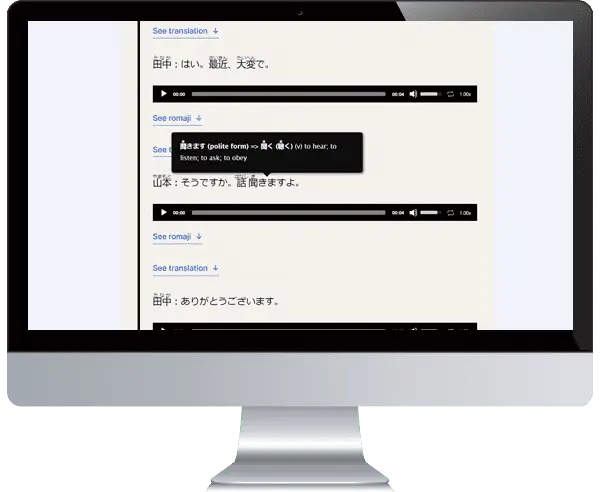
2900+ Easy Dialogues
You will have instant access to our 2900+ easy dialogues. Each lesson is independent and uses limited vocabulary. Just pick interesting ones.
Comprehensible input
You will acquire Japanese with our easy dialogues (implicit knowldge = practical language skills) rather than consciously memorising rules and definitions (explicit knowldge = test-taking skills).
Practical Japanese
You will gain practical Japanese skills rather than test-taking skills that you will typically learn from textbooks and language schools.
Quizzes
You can strengthen your vocabulary and comprehension with our quizzes.
Facebook group (optional)
We have our own Facebook community for additional practice and Q&A.
(This group is optional so you don’t need a Facebook account to subscribe to our course.)
Cancel anytime
You can cancel your subscription at any time. No hidden fees.
Human Support (Not AI)
We have a human customer support team you can speak with.
We don’t use an AI chatbot.
(Please allow us up to 24 hours to respond to your message.)
Our Plans
Yearly 40% OFF (LIMITED OFFER)
$49 $29 USD / mo* (Billed $348 USD Yearly)
* Prices might go up in the future, so reserve your spot now to avoid paying more.
Features included:
- Full membership
- 984+ Level 1 Dialogues
- 492+ Level 2 Dialogues
- 492+ Level 3 Dialogues
- 492+ Level 4 Dialogues
- Access to all levels
- Access to native Japanese teachers to answer your questions
- List of 2000+ High-requency vocabulary
- New vocabulary lesson weekly
- Writing exercises where we correct your Japanese
- Exclusive Facebook group (optional)
- Hiragana & Katakana Course for Beginners
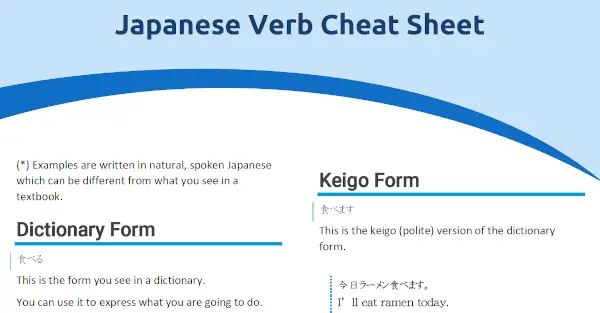
- Bonus 1 - Japanese Verb Cheat Sheet
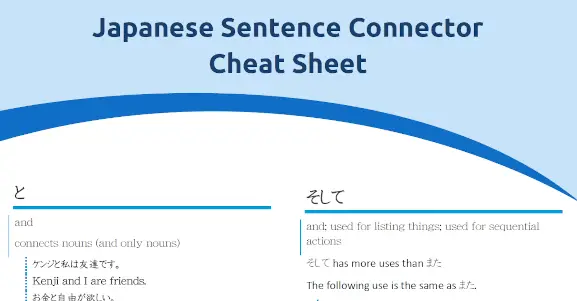
- Bonus 2 - Sentence Connectors Cheat Sheet
- Bonus 3 - Detailed guide of using んだ、の、んです
Monthly
$49 USD / mo*
* Prices might go up in the future, so reserve your spot now to avoid paying more.
Features included:
- Full membership
- 984+ Level 1 Dialogues
- 492+ Level 2 Dialogues
- 492+ Level 3 Dialogues
- 492+ Level 4 Dialogues
- Access to all levels
- Access to native Japanese teachers to answer your questions
- List of 2000+ High-requency vocabulary
- New vocabulary lesson weekly
- Writing exercises where we correct your Japanese
- Exclusive Facebook group (optional)
- Hiragana & Katakana Course for Beginners
- Bonus 1 - Japanese Verb Cheat Sheet
- Bonus 2 - Sentence Connectors Cheat Sheet
- Bonus 3 - Detailed guide of using んだ、の、んです
4 Difficulty Levels
- Level 1 – Up to 250 most frequent words
- Level 2 – Up to 400 words
- Level 3 – Up to 800 words
- Level 4 – 800+ words
For example, Level 1 dialogues only contain the most frequent 250 words. This is great for beginners. Just by learning those 250 words deeply, you will already understand a lot of real-life Japanese.
- Start with any level. And then free to switch over.
- Complete transcription and translation.
- Take as many levels as you want.
- List of new words.
- Quiz for new words.
- No rote memorisation. You will learn words naturally.
With us, it’s impossible NOT to learn words.
You won’t just learn the definitions without knowing how to use it. You will learn nuances and connotations of the words. When you speak Japanese, you just “know” how to use words instinctively.
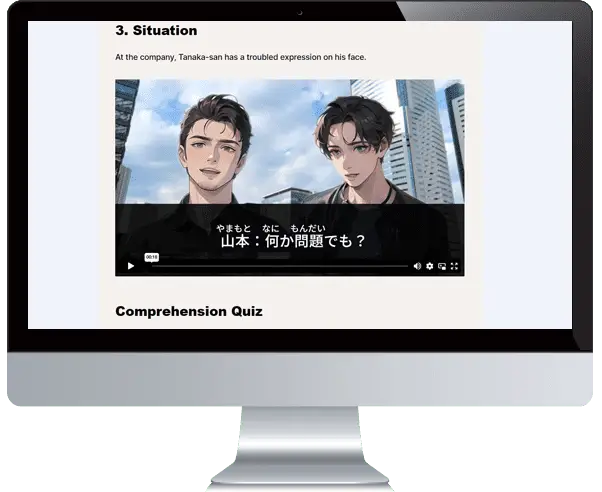
Sample Dialogues
This level is great for beginners who have just started. You will absolutely have to remember those 250 as soon as possible as it will make learning Japanese so much easier.
Level 1 (-250 words, 4 videos)
* the actual lesson comes with the complete translation, word definitions, quizzes and exercises.
Level 2 (-400 words, 2 videos)
If you complete this level, you can express yourself a lot in Japanese. With our course, you can learn your first 400 words with high-quality conversation written with easy grammar.
* the actual lesson comes with the complete translation, word definitions, quizzes and exercises.
Level 3 (-800 words, 2 videos)
You are getting close to being conversational in Japanese. With this level, you will be able to talk about everyday things in Japanese.
* the actual lesson comes with the complete translation, word definitions, quizzes and exercises.
Level 4 (800+ words, 2 videos)
Why stop learning after 800 words? Even if you are at an upper-intermediate level, we’ve got you covered. You can improve your Japanese even further with realistic conversations with more words.
* the actual lesson comes with the complete translation, word definitions, quizzes and exercises.
FAQ
If you learn 1000 of our words and beyond (you will learn up to 2000 words), you will be able to understand more than 60.5% of Japanese text.
While this is not exaclty a near-native level where you can completly understand fast-paced real-life Japanese conversations and express any ideas efortlessly, you will be well equipped to start understanding easy native content.
The crucial step in learning Japanese is getting a lot of input. This course is tailored specifically for people who still find it challenging to understand native content.
Compared to solely using real-life resources (which is still feasible), using this course can accelerate your Japanese learning journey. It saves you the time spent searching for easy content and looking up words and explanations on your own.
Additionally, you get the advantage of having highly-skilled teachers at your disposal to answer your questions and correct your mistakes.
If you’re still finding it challenging to understand native Japanese speakers effortlessly, it’s likely this course won’t be too easy for you
Our course covers the most frequent 1000 words and beyond. Our conversations are written in natural, spoken Japanese which can be very different from textbooks and apps that are based on artificial, written Japanese.
But remember, if you sign up and find that the course is not right for you, you can always cancel.
* Starting from May 15th 2023, we are including romaji on our lowest level (which you can hide), so knowing all the kana isn’t required anymore. Having said that, we strongly recommend learning it as soon as possible.
You don’t need to know kanji. Every kanji in our lessons has furigana.
If you are not confident with your hiragana and katakana, don’t worry. We will give you a free kana course that comes free with the programme.
"Just Use a Flashcard App"
Flashcard apps can help you learn words, but memorizing definitions and a couple of example sentences isn’t enough to completely master words because words are more than just a few definitions.
Take for example the words 仕事する and 働く, which can both be translated as “to work.” But we use them differently in different situations.
- 今日仕事する?Do you work today?
- はたらく細胞!! Cells at Work (manga)
- 将来は外資系で働きたい。(I want to work for a foreign company in the future)
To learn the nuances of words like these, you need to encounter them in a variety of situations.
And if you want to confidently use the word yourself, simply remembering the definitions might not be enough (except for very technical words like 減価償却, “depreciation” in accounting.)
You need to experience them in different situations before you can start using the words naturally when you speak Japanese.
This course will provide you with lots of dialogues where you’ll hear the same high-frequency words in many different situations. With this approach, you’ll truly master these words!
"Just Immerse Bro"
Using real-life resources is definitely a good idea.
- Listening to real-life Japanese people
- Books and news or magazine articles
- Anime, TV shows and movies
- Other recorded material such as YouTube videos
But here’s the thing: When we recommend using native content, a lot of people say they feel overwhelmed and discouraged, because their feel like real-life resources are too difficult.
So we thought about how you can enjoy the benefit of natural, real-life resources without feeling overwhelmed.
Here’s what we will do.
Iinstead of giving you sentences like this:
政府、与党は16日、国の基準を満たしたベビーシッターの利用料にかかる消費税を非課税にする方向で調整に入った。これまでは認可保育所や1日に預かる乳幼児が6人以上の認可外保育施設が非課税対象だったが、シッターや5人以下の小規模な認可外施設にも広げる。
We will give you sentences like this:
- 新あたらしいお店みせ、もう行いった? Have you been to the new shop (restaurant) already?
- どこ? Where is it?
With our course, you’ll acquire basic Japanese through natural and easy dialogues, setting a strong foundation for you to use real-life resources.
We’ll also provide you with the correct definitions and grammar explanations, saving you the time and effort of searching for them yourself. This will save you a lot of time.
"Just Use Textbooks"
Textbooks can be helpful, but there are things you need to be aware of.
Textbooks teach you many uncommon words that Japanese people don’t use very often. While at the same time, they don’t spend enough time teaching you common, useful words.
Let us give you an example from one of the most popular Japanese textbooks, Genki.
I saw this word 務める(tsutomeru)in Chapter 7. It means “to work (for a company)”. Yes, we have yet another word for “to work”!
This doesn’t seem like a “difficult” word, right? But 勤める(tsutomeru) is a rather formal word that we only use in limited situations.
There is a more useful, common word 働く(hataraku) which means “to work (in general)”.
Yet in Genki, 働く(hataraku) only appears much later in Chapter 11. And it only gives you a couple of examples.
(Native Japanese speakers speak differently from textbooks)
Do you remember that knowing 1000 of the most common words, you’ll understand about 60.5% of daily conversations?
textbooks often ignore many of these high-frequency words and expressions.
If you are a beginner, it would be more efficient to focus on useful, common words like 働く and take your time to fully understand them. You can always learn less common words once you master common words.
New lessons every week
Learning Japanese is an ongoing process. You don’t just take a set number of lessons and then finished. There’s always something new to learn.
That’s why we make new lessons every week.
Forgot some words? No problem. You will learn those words again.
Missed some lessons? No problem. Just take the new lessons.
We won’t overwhelm you with too many words
We won’t give you all 1000 at once and overwhelm you – just enough words to remember every week.
Our conversations only use words that are appropriate for your level. They are easy enough for you to understand but challenging enough to make you learn new words.
Just focus on a few words at a time. Remember, it’s important to learn words well, not just a few definitions.
It’s fun because it’s not too easy but not too difficult. You can learn Japanese that way with our course.
Natural, realistic conversations, unlike textbooks and apps
We will teach you how Japanese people speak today in the 21st century – not half a century ago.
We are not afraid to teach you real conversational words and expressions that textbooks won’t. Textbooks might not consider them “official,” but they are inevitable if you want to understand real-life Japanese people because we use them every day.
Just focus on a few words at a time. Remember, it’s important to learn words well, not just a few definitions.
It’s fun because it’s not too easy but not too difficult. You can learn Japanese that way with our course.
It’s Interactive, With Quizzes for new words
With us, you won’t just passively read and listen to our conversations. It’s interactive. Take vocabulary quizzes to test and strengthen your words.
Those quizzes go hand in hand with our high-quality conversations.
Practise your Japanese with us, we are native Japanese teachers
Nobody to practise your Japanese with? Don’t worry, we are here for you! You won’t be completely on your own. We’ve got your back – we are native Japanese people.
(We will teach you how native Japanese people speak.)
After each lesson, we will ask you a simple question in Japanese. You can answer it in Japanese and write to us in the comment section and we will correct your sentences.
Bonuses
“食べられた” or “食べされられた”?
There are essential verb inflexions you need to learn as soon as possible. We made a printable PDF cheat sheet where you can see all the basic verb inflexions.
“から” ”だったら” “なら”?
We will explain important sentence connectors in a printable, PDF format. It may take textbooks a very long time before teaching you those connectors even though they are frequently used on a daily basis. With his cheat sheet, you can learn all of them in a short space of time.